
Understanding the differences between financial buyers and strategic buyers is essential for crafting effective marketing materials. These two buyer types approach acquisitions with different goals, and their priorities influence how they evaluate opportunities:
- Financial Buyers: Focus on profitability, cash flow, and a clear exit strategy within 5–7 years. They assess metrics like EBITDA, revenue predictability, and management stability. Their goal is to optimize the business for resale.
- Strategic Buyers: Seek long-term integration and synergies. They prioritize how the acquisition fits into their existing operations, such as expanding markets, enhancing offerings, or reducing redundancies.
Key Takeaways:
- Financial Buyers value strong financial performance and scalability, relying on data-driven marketing materials like CIMs with detailed financials.
- Strategic Buyers focus on alignment with their business goals, emphasizing growth potential and synergy opportunities in marketing documents.
Tailoring your approach to these priorities ensures your business appeals to the right buyer type, whether they are investment-focused or integration-driven.
🎯 Strategic vs. Financial Buyers: The Valuation Game-Changer 🎬 From DDDM FM Podcast
sbb-itb-798d089
What Drives Financial Buyers vs. Strategic Buyers
The motivations behind financial and strategic buyers create distinct challenges when crafting marketing materials. Financial buyers are primarily focused on acquiring businesses as investments – they aim to improve the company and sell it later for a profit. Strategic buyers, on the other hand, see acquisitions as long-term additions to their operations, seeking businesses that enhance or align with their existing goals.
Because these two buyer types have such different priorities, your marketing strategy needs to address them accordingly. Financial buyers want to see a clear path to profitability and a solid exit strategy, while strategic buyers are more interested in how your business fits into their broader vision. Let’s break down how these differences shape marketing approaches for each type.
Financial Buyers: Returns and Profitability
Financial buyers, including private equity firms, venture capital groups, and family offices, are laser-focused on maximizing returns. They generally aim for annual returns of 20% or more. This means they evaluate every part of the business through a financial lens, looking for strong performance metrics and opportunities for improvement.
"A financial buyer is going to be a professional buyer of businesses… Their goal is to purchase businesses, improve them, and sell them over a five-to-seven-year horizon to get a return on their investment." – MelCap Partners
Key metrics like EBITDA, cash flow, and operational efficiency carry significant weight in their decision-making process. Since financial buyers often lack deep expertise in the industry they’re entering, they rely heavily on the existing management team to maintain and grow the business. This makes it essential to highlight the strength and stability of your leadership team in your marketing materials, assuring them that the company can succeed without their direct involvement.
Another critical factor is the investment horizon. Financial buyers plan their exit strategy from the start – whether through a sale or IPO within three to seven years – and often use significant debt (up to 80%) to fund the acquisition. To win their interest, your materials should showcase predictable revenue streams, low customer concentration, and clear growth potential. These elements demonstrate that the business can repay debt and generate a strong resale value.
Strategic Buyers: Synergies and Growth
Strategic buyers aren’t looking for a short-term investment – they’re focused on long-term integration and creating competitive advantages. These operating companies, which represent around 70% of the total M&A market, are often willing to pay a premium for businesses that align with their strategic goals.
"Strategic buyers realize financial returns from synergies, in addition to the future cash flows from the company on a stand-alone basis, so strategic buyers can afford to pay a higher valuation." – Michael Cohen, Impact Capital Group
What sets strategic buyers apart is their focus on synergy value – the idea that the combined value of two companies is greater than the sum of their parts (1+1=3). They look for opportunities to create value beyond standalone financial performance, such as cross-selling products, filling technology gaps, eliminating competitors, or expanding into new markets. These synergies often justify paying a higher valuation because they factor in the economic benefits of integration.
Unlike financial buyers, strategic buyers often integrate their acquisitions with existing management teams and operations. They may view certain back-office functions as redundant and seek to streamline costs through consolidation. When targeting strategic buyers, your marketing should emphasize how seamlessly your business can integrate with theirs. Highlight unique operational strengths, potential cost savings, and how your company can contribute to their broader goals. This approach showcases the value of working together for long-term success.
Marketing Materials That Work for Financial Buyers
When targeting financial buyers, your marketing materials need to be precise, data-driven, and packed with relevant financial details. These buyers rely heavily on numbers to make decisions, so providing clear, accurate financial data is non-negotiable. At the heart of these materials is the Confidential Information Memorandum (CIM) – a cornerstone document for investment analysis.
"The most important information included in a CIM is arguably the financials – the data that’s going to drive the sale and/or investment." – Alex Karlsen, Captarget
Creating CIMs for Financial Buyers
To appeal to financial buyers, your CIM must present financials that reflect the true earning potential of your business. This involves normalizing financial data by adjusting for one-time expenses (like legal fees) and non-operational owner benefits (such as personal vehicle expenses or inflated salaries). Including a detailed Adjusted EBITDA schedule can help establish credibility.
Your CIM should also highlight Trailing Twelve Months (TTM) revenue and adjusted EBITDA, offering a clear and current snapshot of performance. Financial buyers often focus on EBITDA and net income as key metrics for valuation. Additionally, include a working capital peg with a baseline and explanations of seasonality to clarify liquidity requirements post-acquisition.
When presenting growth projections, be specific and grounded. Instead of relying on overly optimistic forecasts, outline tangible growth strategies, such as hiring sales teams for untapped markets or introducing automation to cut costs. Sophisticated buyers value realistic, actionable plans over inflated predictions.
Proactively address potential risks by including a "Risks & Mitigations" section. This should detail financial vulnerabilities, such as customer concentration, alongside strategies to manage them. Transparency is key – cover revenue recognition policies and any multi-element arrangements to avoid surprises during due diligence. Lastly, emphasize management depth to reassure buyers of operational continuity.
Once your CIM is in place, the next step is preparing Offering Memorandums (OMs) to support the due diligence process.
Supporting Due Diligence with OMs
While CIMs lay the financial groundwork, Offering Memorandums (OMs) provide the in-depth analysis financial buyers need during due diligence. OMs should include detailed financial records, such as monthly closes tied to bank statements, AR/AP aging reports, and revenue breakdowns by geography, product, and customer to assess concentration risks.
Accuracy is paramount. Ensure monthly closes align with bank statements to maintain data integrity. Having a Quality of Earnings (QoE) report in progress or completed can further strengthen credibility, confirming the reliability of your earnings. Financial buyers, who often use debt to fund acquisitions, need confidence that your business can generate sufficient free cash flow to cover interest payments.
For businesses looking to streamline this process, Deal Memo offers professionally crafted CIMs and OMs within 72 hours. These documents are designed to meet the exacting standards of financial buyers, featuring normalized financials, detailed EBITDA schedules, and comprehensive due diligence materials tailored for investment-focused audiences.
Marketing Materials That Work for Strategic Buyers
Strategic buyers approach acquisitions with a completely different mindset than financial buyers. They’re not just crunching numbers – they’re evaluating how your business fits into their operations and what synergies it can unlock. Your marketing materials must address these priorities head-on, showcasing growth potential and how seamlessly your company could integrate into their strategy.
"Strategic buyers may value the company being presented differently than a pure financial buyer, for example. It is important early on in the presentation process to ensure that the possible buyer understands what drives value for the company, why it is unique and how it is positioned in the context of a competitive marketplace."
- Alex Karlsen, Captarget
Teaser Documents That Highlight Strategic Fit
The teaser document is your first opportunity to grab the attention of a strategic buyer. Unlike teasers aimed at financial buyers, which focus heavily on cash flow and profitability, a strategic teaser should emphasize your company’s market position, customer base alignment, and potential efficiency gains. Keep it anonymous but impactful. If your business operates in a market that complements the buyer’s or serves overlapping customers, make that immediately clear. Strategic buyers need to see the "why now" and "why us" right away.
The goal is to position your company as the perfect addition to their growth plan – whether that’s expanding into new regions, acquiring innovative technology, or gaining tighter control over the supply chain. After piquing their interest with the teaser, more detailed documents like CIMs and OMs will provide the in-depth information they need.
CIMs and OMs That Focus on Synergies
Once a strategic buyer signs an NDA and receives your Confidential Information Memorandum (CIM), the document must go beyond financial history to paint a compelling strategic picture. The Investment Thesis section is especially critical – it should clearly outline how your business can serve as a platform for market entry, drive cross-selling opportunities, and deliver value through operational efficiencies and cost savings.
"To appeal to the strategic buyer community… a CIM should focus on targeted revenue growth, operational optimization (strategic sourcing, cost reduction in all functions), and reduction in financial cost and investment."
Break down revenue by geography, product, and business unit, allowing buyers to quickly assess how your company aligns with their corporate goals. Include a "Growth Opportunities" section that moves beyond vague statements to detail actionable plans, like launching into a new healthcare segment with a dedicated sales team. Strategic buyers often justify paying premium valuations – sometimes 20% to 40% above intrinsic value – when synergy opportunities are clearly outlined.
Additionally, a whitespace analysis can help highlight where buyers could cross-sell to your existing customers, while an employee profile section can assist in planning personnel integration and identifying potential cost-saving redundancies. Including metrics that demonstrate integration readiness strengthens the case for your company’s strategic value.
For a fast turnaround, services like Deal Memo can create tailored CIMs and OMs in as little as 72 hours, effectively showcasing your company’s synergy potential and strategic fit.
Marketing Priorities: Financial vs. Strategic Buyers
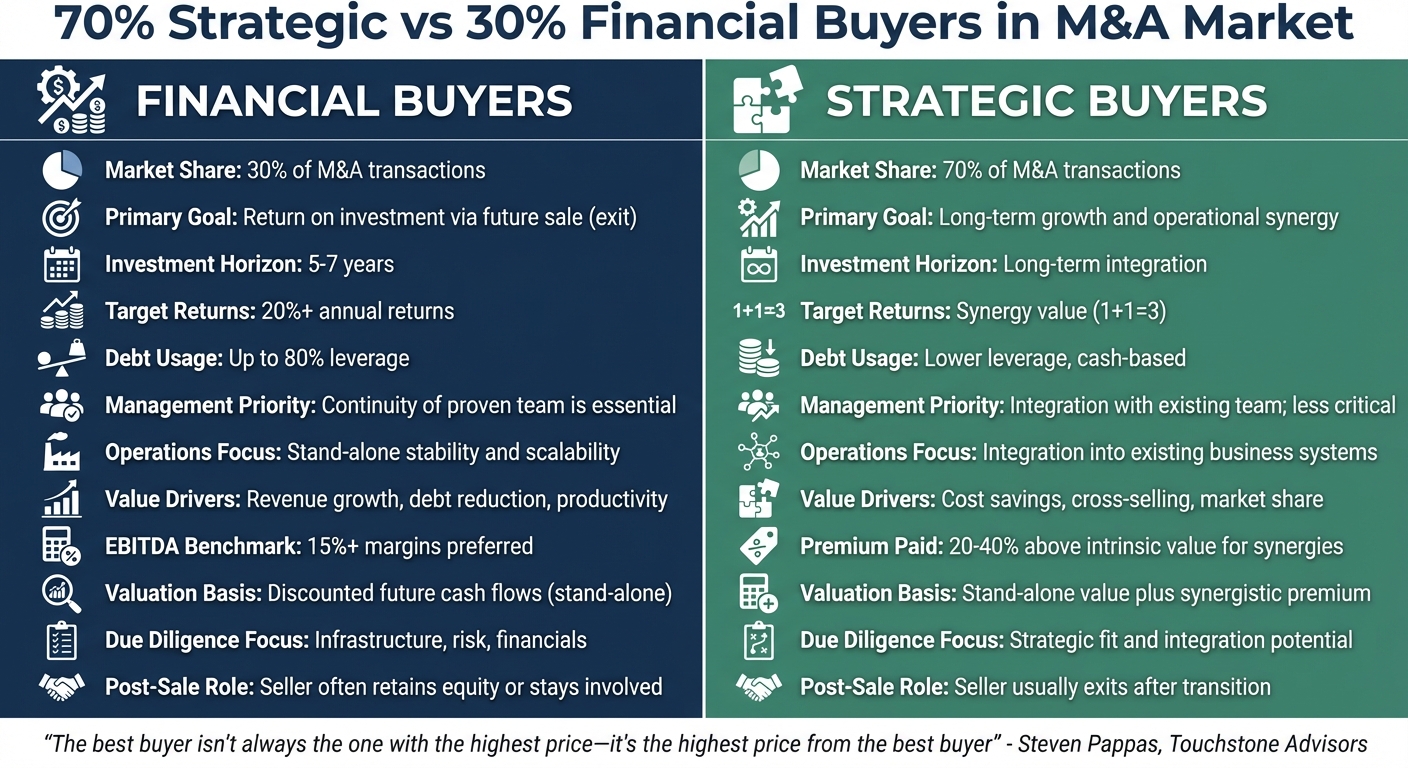
Financial Buyers vs Strategic Buyers: Key Differences in M&A
When preparing marketing materials like Confidential Information Memorandums (CIMs) or Offering Memorandums (OMs), it’s crucial to tailor them to the priorities of your target buyer. Financial buyers and strategic buyers have distinct motivations, and understanding these differences can help you align your messaging effectively.
Financial buyers focus on the numbers. They want to see strong, stand-alone performance with clear, measurable returns over a 5-to-7-year period. Their primary concerns include financial stability, infrastructure, and risk management. While they value a stable management team, their main priority is ensuring the business can scale and generate reliable financial returns.
Strategic buyers, on the other hand, are all about fit. They look for opportunities to integrate your business into their existing operations, aiming to achieve synergies. These could include cost savings from centralizing administrative functions, revenue growth through cross-selling, or expanding into new markets using your geographic footprint. Their due diligence focuses on assessing how well your business aligns with their strategic goals and whether integration will be smooth.
"The best buyer isn’t always the one with the highest price – it’s the highest price from the best buyer and how they will align with your goals and objectives."
- Steven Pappas, Partner, Touchstone Advisors
In the M&A market, strategic buyers dominate, making up about 70% of all transactions, while financial buyers account for the remaining 30%. The table below highlights the key differences in what each buyer type values when evaluating a potential acquisition.
Comparison Table: Marketing Focus by Buyer Type
| Feature | Financial Buyer Priority | Strategic Buyer Priority |
|---|---|---|
| Primary Goal | Return on investment via a future sale (exit) | Long-term growth and operational synergy |
| Management | Continuity of proven team is essential | Integration with existing team; less critical |
| Operations | Stand-alone stability and scalability | Integration into existing business systems |
| Value Driver | Revenue growth, debt reduction, productivity | Cost savings, cross-selling, market share |
| Valuation Basis | Discounted future cash flows (stand-alone) | Stand-alone value plus synergistic premium |
| Due Diligence | Focus on infrastructure, risk, financials | Focus on strategic fit and integration |
| Post-Sale Role | Seller often retains equity or stays involved | Seller usually exits after a transition |
Financial buyers often have specific benchmarks, such as EBITDA margins of 15% or higher, to ensure a solid return on investment. Strategic buyers, however, may be willing to pay above the intrinsic value of the business if they can clearly identify and achieve synergy opportunities.
How to Tailor CIMs and OMs for Each Buyer Type
Customizing for Financial Buyers
When dealing with financial buyers, the numbers need to tell a convincing story. Your CIM or OM should include a detailed add-back reconciliation bridge to clearly demonstrate how you transition from GAAP earnings to Adjusted EBITDA. This level of transparency not only builds trust but also streamlines the due diligence process. Additionally, include financial models that highlight debt capacity and the potential for add-on acquisitions, showing how leverage can amplify returns.
Don’t shy away from addressing weaknesses. Whether it’s customer concentration or other risks, outline these issues directly and provide concise mitigation strategies. This proactive approach reassures buyers, preventing them from jumping to negative conclusions. It’s also crucial to emphasize management continuity and scalability. Financial buyers typically have a 5- to 7-year investment horizon, relying on a strong, proven team to drive steady cash flow during that period.
Customizing for Strategic Buyers
Strategic buyers are more focused on alignment and growth potential. Start by clearly defining your business’s economic moat – what sets you apart and why customers choose you. Detail how this advantage can scale when integrated into the buyer’s existing operations. Highlight specific synergy opportunities, such as cross-selling to existing customers, cutting redundant back-office costs, or expanding into untapped geographic markets.
Make sure to showcase the "blue sky" opportunities – those untapped growth areas that a strategic buyer could capitalize on. However, if your potential buyers are industry competitors, confidentiality becomes a key concern. Protect your business relationships by redacting sensitive customer or vendor information until later stages of due diligence.
"A CIM is a marketing document, not an accounting spreadsheet. All the data you present must be woven into a compelling narrative." – Doreen Morgan, Sunbelt Atlanta
These strategies help create materials that resonate with the specific priorities of each buyer type.
How Deal Memo Simplifies Tailored Content Creation
Creating tailored CIMs and OMs is no small task, and that’s where specialized services like Deal Memo come into play. Their white-labeled solutions streamline the process, delivering customized materials in as little as 72 hours. It all starts with an in-depth seller interview, designed to uncover hidden strengths like high customer retention rates or proprietary processes that appeal to different buyer profiles.
From there, Deal Memo’s team crafts the investment thesis to align with the target audience. For financial buyers, the focus is on platform potential and debt capacity. For strategic buyers, they emphasize integration benefits and cost-saving synergies. Plus, with unlimited revisions and a dedicated account team, you get materials that are fine-tuned to position your business effectively – all while keeping your firm’s branding consistent.
Conclusion
Understanding your buyers is crucial: financial buyers focus on standalone profitability and achieving a clear ROI within 5–7 years, while strategic buyers prioritize synergies and long-term growth opportunities.
Your marketing materials need to reflect these differing priorities. For financial buyers, emphasize metrics like adjusted EBITDA, cash flow, and a clear exit strategy. On the other hand, when targeting strategic buyers, highlight opportunities for untapped growth, cross-selling, and operational improvements.
"The CIM is an essential marketing document that helps position your company and establishes the key themes and opportunities for the business that will guide the rest of the process." – Software Equity Group
FAQs
What’s the difference in how financial buyers and strategic buyers evaluate acquisitions?
Financial buyers zero in on a business’s individual financial performance and its ability to deliver solid cash returns. They care about numbers like historical income, EBITDA trends, and consistent cash flow. Their main objective? Positioning the business for a future sale, often within 5 to 7 years. To achieve this, they focus on maximizing return on equity, ensuring the business can handle debt payments, and finding ways to improve operations.
Strategic buyers, however, take a different approach. They evaluate acquisitions based on synergies and integration possibilities. Their focus is on how the target’s products, technologies, or customer base can enhance their current operations. By doing so, they aim to create extra value through cost savings, revenue growth, or expanding their market presence. Because of this potential, strategic buyers are often willing to pay more to secure these advantages.
What marketing materials work best to attract financial buyers?
Financial buyers are all about the numbers. They want to see the cash-generating potential of a business clearly laid out. To grab their attention, your marketing materials should focus on solid financial data and growth opportunities. Here’s what you need:
- Teaser Document: This is your one-page pitch. It should highlight the deal size, EBITDA, growth trends, and your investment thesis in a concise and compelling way.
- Confidential Information Memorandum (CIM): Think of this as the deep dive. It includes audited financials, cash flow projections, profiles of the management team, and details about the company’s market position.
- Management Presentation: This visual presentation should spotlight financial performance, key value drivers, and potential exit strategies.
These tools are designed to give financial buyers the data they need to quickly evaluate profitability, weigh risks, and gauge the long-term potential of the business.
Why do strategic buyers often pay more for acquisitions?
Strategic buyers often pay more for acquisitions because they anticipate long-term benefits from combining operations. These benefits might include boosting revenue, cutting costs, entering new markets, or enhancing their current operations.
When a business aligns with their broader goals, strategic buyers see the potential to gain efficiencies and strengthen their competitive position – making the higher price worthwhile.